
British Museum funds research on Kashmir’s last houseboat makers and the vanishing craft
For The Hindu (Sunday Magazine)
Published on 2 May 2026
As Kashmir’s houseboat craft fades after decades of a ban on new constructions, the British Museum backs a project by a Pune team to capture its last remaining artisans
When you take into account that houseboat construction in Kashmir has been stopped for decades, the Delhi Development Authority’s proposed ₹4-crore houseboat plan in Delhi underscores a striking irony. Meanwhile, a British Museum-funded project has been documenting the techniques and oral histories of Kashmir’s last-remaining artisans. The research, now complete, is ready for submission this month.
Nearly four decades ago, the Jammu & Kashmir government banned the construction of new doongas (houseboats) to curb unregulated growth and pollution in Dal Lake. Since then, many master craftsmen have died, leaving behind only a few practitioners such as Ghulam Ahmad Najar, 67. “I am bound to these boats; there is nothing else I know,” says the boat maker from Bandipora.
Funded by British Museum’s Endangered Material Knowledge Programme, the project which began in October 2024 has drawn attention to the craftsmen themselves. Last year, in Srinagar, in the presence of the director of J&K’s Department of Handicrafts, master craftsmen were felicitated, with the promise that the hull builders, who also repair houseboats, will be included in the list of Kashmiri craftspeople, making them eligible for government schemes, loans, and other support.
Retracing the legacy
According to popular perception, the British are credited for introducing houseboats in the Kashmir valley. But Sayali Athale and architect Anto Gloren, researchers leading the project, say the craft is at least “400-500 years old” and is an intrinsic part of the region’s cultural heritage. “These floating dwellings have been around since the time of the Mughals, and have been mentioned in Ain-e-Akbari and Jahangir-Nama,” she says.
Houseboats have been a way of daily life in Kashmir. In the 1920s-’30s, says Athale, doongas were used to travel from Srinagar to Anantnag, a road distance of 60km today. Master craftsman Abdul Khaliq Najar says, “In the earlier times, until around 1947, a type of boat called bahast was made in order to navigate the canals throughout the city. It would transport rice, wheat flour, firewood.” Once roads were built, bahasts faded away.
The documentation project has brought to the forefront voices of the four remaining master craftsmen, called wasta in Kashmiri, and their vast repository of traditional knowledge. Among them, Nazir Ahmed Kawdari died in his late 50s this January, leaving behind Abdul Khaliq Najar, and brothers Ghulam Ahmed Najar, 67, and Mohammad Subhan Najar, 65. “While all their sons have, at some point, assisted them in the process (of boat-making), whether they will be able to build such boats themselves remains to be seen,” Gloren says.
Challenges on the way
In 1988, the construction of new houseboats was stopped, citing them as the main cause of pollution in Dal Lake. “Before this, thousands of houseboats could be found on Dal and Nigeen lakes and the Jhelum river; today, fewer than 750 remain,” says Gloren.
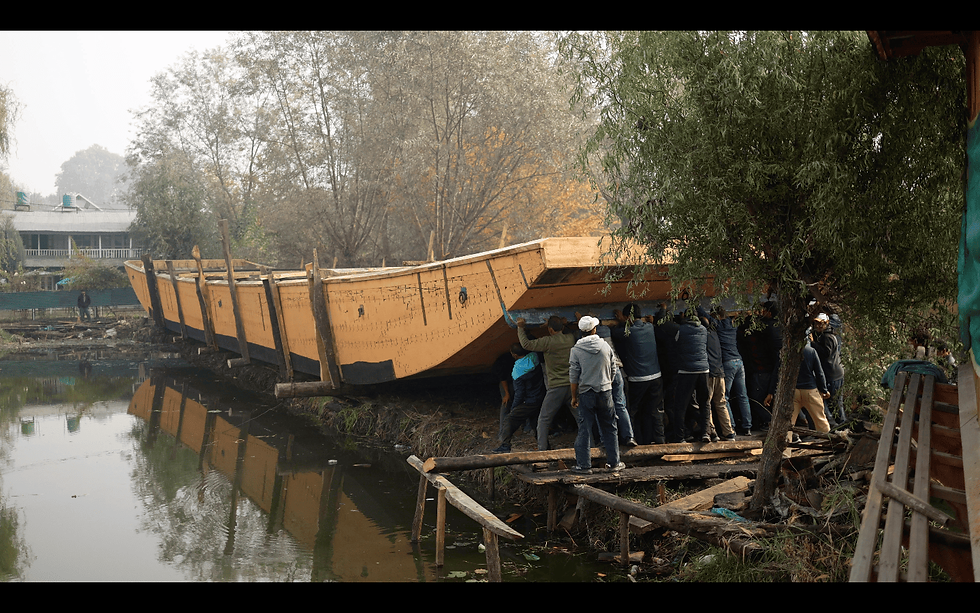
Houseboat-making is a tedious process. The making of the hull alone takes five-six months. The researchers, however, could witness the craft’s detailing during the rebuilding work permitted after the 2022 Nigeen Lake fire gutted seven houseboats. “One of the highlights of this documentation was the ceremony of pushing the completed hull of the boat into the water before commencement of superstructure construction. If boats are constructed in the Dal or Nigeen boatyard, the sluice gates are used to move the hull into the lake, so this ceremony is rare,” Athale says. “Since this houseboat was constructed on the lake’s edge, they moved it in the traditional way with almost a hundred community members pushing the 120 ft-long hull into the waters.”
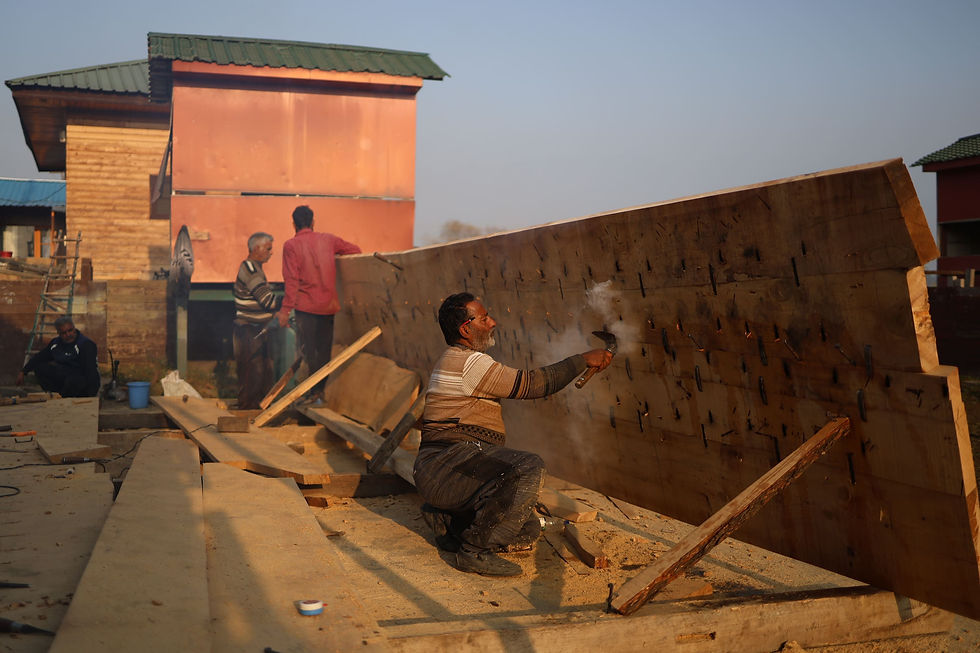
In 2023, a new houseboat policy provided for minor repairs to existing doongas and houseboats, albeit with no mention of the techniques or materials to be used. The houseboats are traditionally made with Deodar wood but owing to a lack of forest timber now, they are being repaired using wood from old buildings and bridges. While this timber is of high quality and seasoned through decades of use, they are of different sizes, forcing a change in construction technique, thereby affecting the boats’ quality. “The biggest change is that since only smaller pieces of wood are available now, there are more joints in the boat,” Athale says. The pasch, the boat’s longest structural part on either side of the hull, that holds the boat together, would earlier be one piece. But now it is made as three pieces and joined. “Since the houseboats are now tethered to the lake’s edges and not expected to travel far, the large number of joints isn’t much of a problem,” she adds.
A glimmer of hope
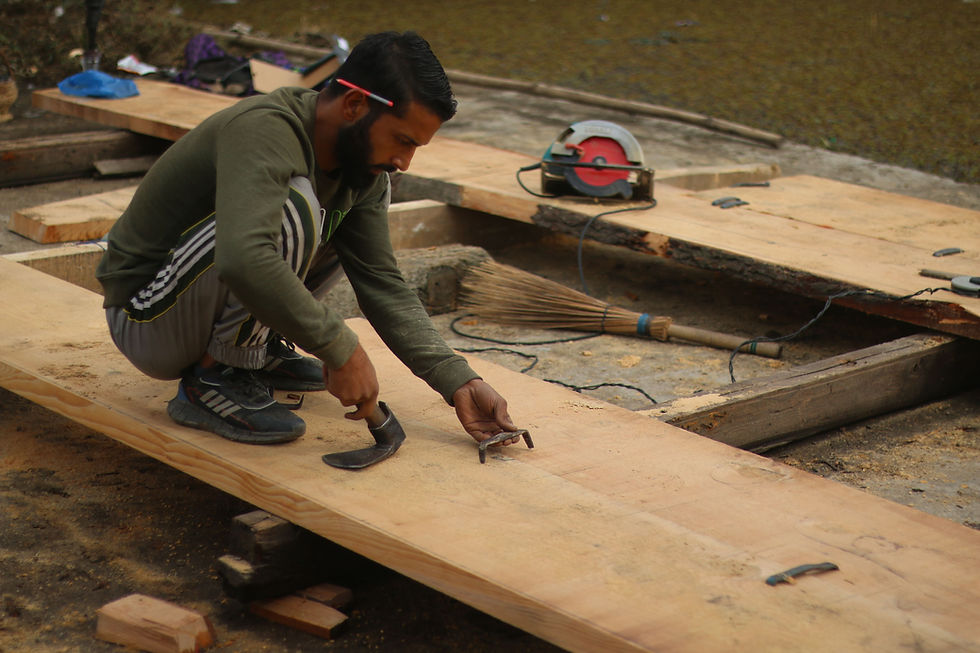
The master craftsmen have been building smaller boats — for sand-dredging, fishing, transport, and shikaras — and, since the last two years, they have been rebuilding the charred houseboats. This is their only means of livelihood, says Abdul Khaliq Najar, even though the younger generation has sought other means of employment. “Among the sons, some own grocery stores, pharmacies, one is in the police, and some work as carpenters,” Athale says.
But Ghulam Ahmad Najar is hopeful: that with the government’s recent felicitation, their knowledge will not be lost. “The data collected will be available in an open-access platform. And the community will have access to the methods and techniques employed by their predecessors, for posterity,” adds Gloren.


keonhacai dạo này thấy mọi người nhắc hoài nên mình cũng bấm vào nghía thử cho biết. Mình không đọc sâu nội dung đâu, chỉ lướt xem trang họ làm giao diện kiểu gì thôi. Cảm giác đầu tiên là nhìn khá dễ chịu, không bị rối mắt, mấy phần thông tin được chia thành từng khối rõ ràng nên kéo xuống vẫn theo dõi được. Mình cũng để ý menu đặt ngay chỗ dễ thấy, bấm qua lại vài mục là hiểu mình đang ở đâu, không phải mò. Nói chung kiểu trình bày này hợp với ai chỉ muốn nhìn nhanh rồi nắm ý chính, không cần căng não. Mình thích nhất là các khung bảng hiển thị…
Bài viết đọc cuốn ghê, mình đọc một mạch hết luôn, cảm ơn bạn đã chia sẻ. Dạo này mình cũng hay để ý mấy nền tảng giải trí trực tuyến nên vào xem chủ yếu phần giao diện, cách chia mục và cách họ trình bày bảng thông tin cho dễ lướt. Mình gom mấy thứ hay gặp vào một trang riêng để tiện xem lại; ai cần tham khảo thì ghé https://www.lummi.ai/creator/Soicauxsmbpro